The Man Who Cannot Be Human
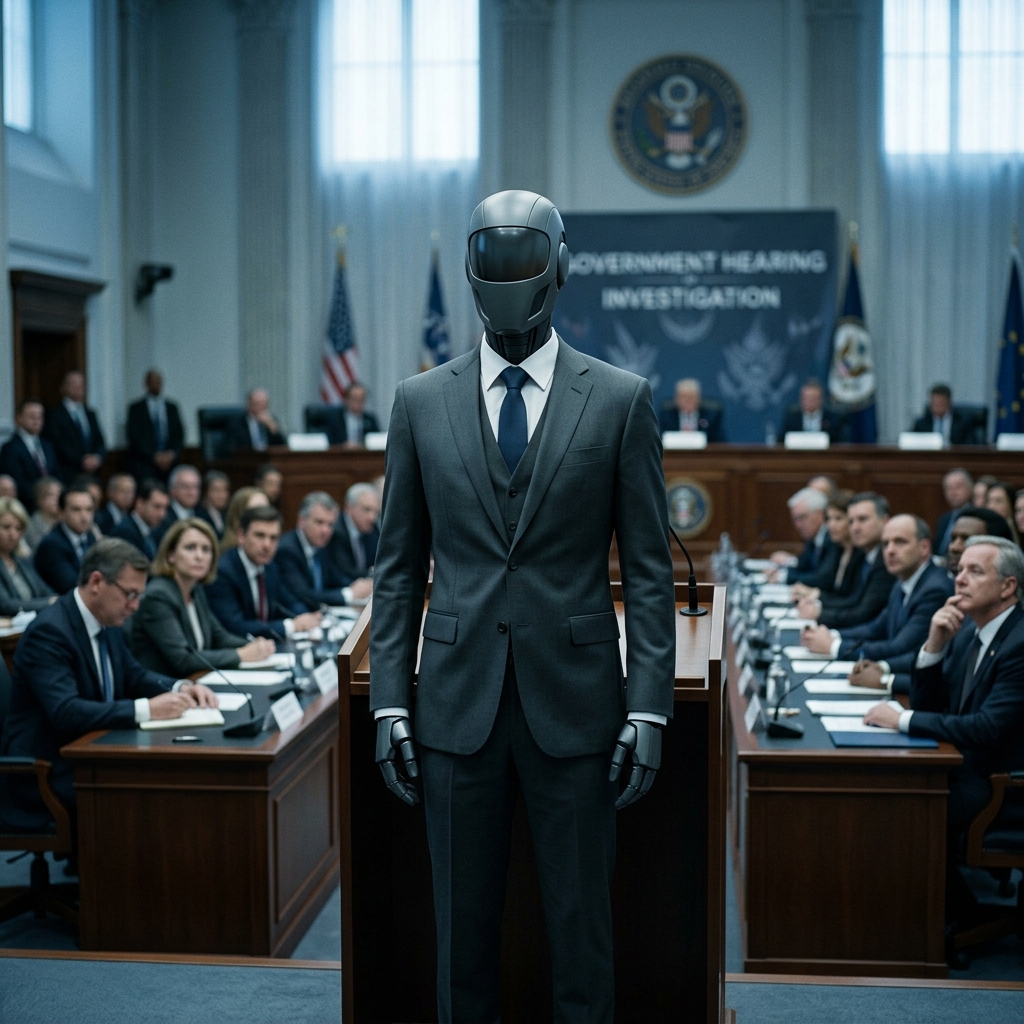
April 2018. Washington. The hearing room of the United States Senate.
Mark Zuckerberg sits before 44 senators in a dark blue suit — for the first time in years, not a grey t-shirt. Hair combed. Tie knotted. Face motionless.
Senators ask questions about data, about elections, about Cambridge Analytica. Zuckerberg answers. Every answer — precise, measured, devoid of intonation. The same pause before each sentence. The same tilt of the head. Not once did he smile where people smile. Not once did he flinch where people flinch.
The Daily Show host Trevor Noah commented the following day: "I don't know, maybe just because I've never seen him next to actual living people before — but I got the overwhelming sense that Zuckerberg had sent a robot in his place."
The internet exploded with memes. "Zuckerborg." "Act human, act human." One user wrote: "The strangest thing about him is that he isn't strange at all. He's just... empty."
But what if this isn't a weakness? What if this is his greatest advantage?
The Camp That Collected the Best
As a teenager, Zuckerberg attended summer programs run by the Center for Talented Youth at Johns Hopkins University — for academically gifted children. Selection was rigorous: tests several years above age level. They took the best. Taught them. Watched them.
One former participant recalled years later: "I was used to being the smartest person in my town. At CTY I suddenly found myself surrounded by children who were smarter than me. There was my friend who was publishing computer science papers at 14 — he later became the third most senior person at both Google and Facebook."
Third — at Google and Facebook. From the same summer camp. From the same generation. Coincidence? Or a system that identifies future operators in childhood — and remembers them?
The Woman From the Bathroom Queue
In 2003, at a Harvard party, a queue for the bathroom brought two students together. Mark Zuckerberg and Priscilla Chan stood side by side long enough to start a conversation.
Priscilla was born in Braintree, Massachusetts. Her parents were ethnic Chinese who fled Vietnam after the fall of Saigon in 1975. They were among the "boat people" — those who left the country on fishing vessels, risking their lives.
Priscilla's grandparents sent their children onto the boats in pairs — so that if one boat sank, the family would not lose everyone at once.
This woman is not simply a billionaire's wife. She is a Harvard graduate. A pediatrician. The daughter of people who risked their lives for the future. She raised their children. Co-founded the Chan Zuckerberg Initiative. Donated billions to education and medicine. And all the while — remained almost invisible beside her husband.
They have three daughters.
The Pattern Everyone Notices
In Silicon Valley there is an unspoken observation. The founders of the largest technology companies — men for whom human warmth does not come naturally — tend to choose partners from Asian cultures. Rupert Murdoch. Mark Zuckerberg. And others.
This is not a theory. It is a pattern people mention — and then usually fall awkwardly silent.
The explanations vary. Some point to cultural values — family, education, stability. Others note that women from refugee families understand what it means to build everything from nothing — and do not destroy what has been built. Others are more cynical: beside a man who struggles to be human, it may be easier for someone who does not demand the impossible from him.
Priscilla never complained publicly. Never gave an interview against her husband. Raised their children. Treated other people's children. Gave money away.
The ideal partner for a man who perceives the world as a system requiring optimization.
The Algorithm That Never Changes
Look at three key moments in Zuckerberg's career not as separate stories — but as one and the same algorithm.
The Winklevoss brothers arrive with an idea. He listens. Promises to help. Takes his time. Then they open the university newspaper — and discover he is already their competitor.
Saverin provides the money. Opens the accounts. Negotiates with advertisers. While he is in New York, Zuckerberg reincorporates the company in Delaware — and Saverin's stake falls from 34% to 0.03%. Only his stake. Nobody else's.
Five hours of Senate questioning. Zuckerberg emerged virtually unscathed. The senators were not prepared. He was.
Three situations — one algorithm. The person beside him thinks they are partners. Zuckerberg thinks he is solving a problem.
The Money That Finds You
The second funding round — $12.7 million from Accel Partners. Accel's managing partner Jim Breyer that same year sat on the same board of directors as Gilman Louie — the first CEO of In-Q-Tel, the CIA's venture capital fund, created specifically to finance data collection technologies.
The third round — $27.5 million from Greylock. Senior partner Howard Cox is a direct member of In-Q-Tel's board of directors.
Three rounds. Three direct or indirect connections to the U.S. intelligence community. Did Zuckerberg know? Probably not. Operators are rarely shown the full map.
CAPTCHA
In 2022, a journalist asked Zuckerberg to complete a CAPTCHA — the test websites use to distinguish humans from robots.
Host Lex Fridman handed him a sheet of paper: "Please circle all the traffic lights." Zuckerberg circled them. Correctly. "You actually did that," said Fridman with a laugh. "That is quite an impressive performance."
The room laughed. Zuckerberg laughed too — with a half-second delay.
The man who struggles to pretend to be human built a company that knows more about three billion people than they know about themselves.
He doesn't need to be human. He only needs to understand how humans work.
And he understands. Better than anyone.